


Europe Education Apps Market Size, Share & Analysis, 2034
Europe Education Apps Market Size
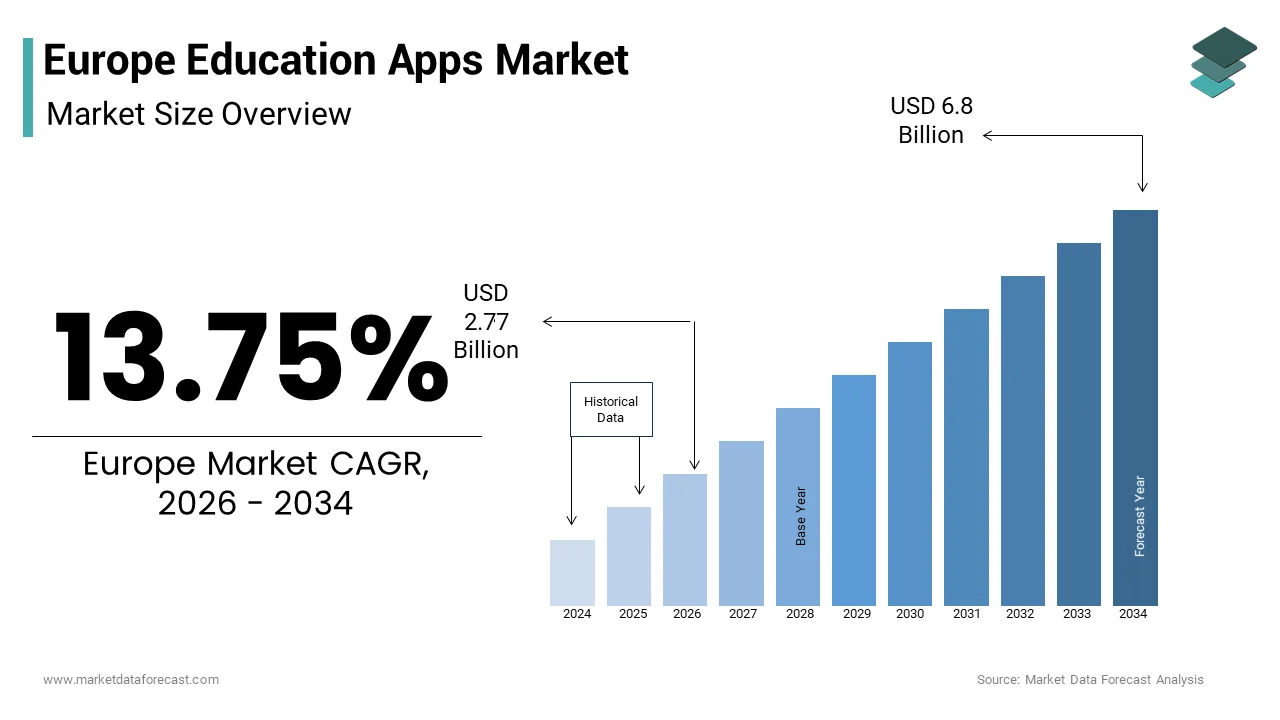
The Europe education apps market size was valued at 2.43 billion in 2025 and is anticipate to reach USD 2.77 billion in 2026 to reach USD 6.8 billion by 2034, growing at a CAGR of 13.75% during the forecast period from 2026 to 2034.
Introduction to the Europe Education Apps Market
Education apps encompasses a diverse ecosystem of digital applications designed to facilitate learning, skill acquisition, and academic support across various educational levels. This sector includes language learning platforms, test preparation tools, coding bootcamps, and interactive classroom management solutions that leverage mobile and web technologies. The region is characterized by a strong emphasis on digital literacy and lifelong learning, driven by both institutional mandates and individual career aspirations. As per Eurostat, 94.2% of households in the European Union had access to the internet in 2024, creating a robust infrastructure for digital education delivery. This high connectivity rate enables seamless access to educational content, regardless of geographical location. Furthermore, as per Eurostat, the participation rate in formal or non-formal education and training among adults of working age in the EU stood at 46.6% in 2022. The integration of artificial intelligence and adaptive learning algorithms allows these applications to provide personalized educational experiences, tailored to individual pacing and learning styles. According to the Organisation for Economic Co-operation and Development, digital competence is increasingly recognized as a key factor for employability, prompting governments to invest in digital educational resources. The definition of this market extends beyond simple content delivery to include interactive engagement, gamification, and real-time assessment tools. The regulatory landscape, including the General Data Protection Regulation influences how student data is collected and processed, ensuring privacy and security. This environment fosters trust among users and encourages wider adoption of digital learning solutions. The convergence of technology and pedagogy defines the current trajectory of this dynamic sector.
MARKET DRIVERS
Increasing Demand for Upskilling and Reskilling in the Digital Economy
The rapid evolution of the labor market and the increasing demand for digital skills is a key market driver for the Europe education apps market. As automation and artificial intelligence transform industries, workers are compelled to continuously update their skills to remain competitive. According to the European Centre for the Development of Vocational Training, 49.0% of all upper-secondary students in the EU were enrolled in vocational education in 2022. This perception drives individuals to seek flexible and accessible learning solutions, such as mobile education apps, that offer courses in coding, data analysis, and digital marketing. The flexibility of these platforms allows learners to study at their own pace, fitting education into busy professional schedules. As per the International Labour Organization, the transition to a green and digital economy creates new job roles that require specialized knowledge, not always covered in traditional education systems. Education apps fill this gap by providing targeted micro-credentials and certifications that are recognized by employers. The rise of the gig economy further incentivizes independent professionals to diversify their skill sets through affordable digital courses. Governments across Europe are also promoting lifelong learning initiatives, supporting the adoption of these tools. The accessibility of high-quality content from global providers enhances the appeal of education apps. This trend is particularly strong among young professionals and mid-career workers seeking career advancement. The democratization of education through mobile technology ensures that upskilling opportunities are available to a broader audience. This structural shift in workforce requirements sustains the long-term growth of the market.
Government Initiatives Promoting Digital Literacy and Inclusive Education
Strategic government initiatives that aimed at enhancing digital literacy and ensuring inclusive education is further contributing to the expansion of the European education apps market. The European Union’s Digital Education Action Plan outlines a vision for a high-performing digital education ecosystem that supports the needs of students and educators. According to the European Commission, 55% of people in the EU aged 16 to 74 had at least basic overall digital skills in 2023. This policy framework drives public investment in digital infrastructure and educational software, including mobile applications. As per Eurostat, almost 9 out of every 10 people aged 16 to 74 years in the EU made use of the internet on a daily basis in 2024. Governments are partnering with edtech companies to develop apps that cater to diverse learning needs, including those of students with disabilities. These collaborations ensure that educational content is accessible and aligned with national curricula. The focus on reducing the digital divide prompts subsidies for devices and internet access in underserved communities. Schools and universities are increasingly incorporating app-based learning into their pedagogical strategies to engage students. The emphasis on STEM education further boosts the demand for interactive learning tools. Regulatory support for data privacy and security builds trust among parents and educators. These public sector efforts create a favorable environment for market expansion. The alignment of educational policies with technological innovation ensures sustained demand for digital learning solutions.
MARKET RESTRAINTS
Stringent Data Privacy Regulations and Compliance Complexities
The rigorous data protection laws in Europe, particularly the General Data Protection Regulation is primarily hampering the European education apps market growth. These regulations require strict consent mechanisms and data minimization practices, which can complicate the collection of user data necessary for personalized learning experiences. According to the European Data Protection Board, the penalty fines for non-compliance to GDPR can go up to 20 million euros or 4% of the annual worldwide turnover, whichever is greater. Education apps often collect sensitive information about minors, requiring additional safeguards and parental consent protocols. As per the UK government, more than 100,000 people are expected to benefit from the Erasmus+ program in the first year alone following the UK rejoining. The need for transparent data handling practices increases development costs and time to market. Users may be hesitant to share personal learning data due to privacy concerns, limiting the effectiveness of adaptive algorithms. The requirement for data portability and the right to be forgotten further complicates database management. Cross-border data transfers, within and outside the EU, are subject to strict restrictions, affecting multinational app providers. The complexity of ensuring compliance with varying national interpretations of the law adds to the administrative burden. Organizations must invest heavily in legal expertise and compliance infrastructure to navigate this landscape. This regulatory uncertainty can deter smaller startups from entering the market. The fear of reputational damage from privacy breaches also inhibits aggressive data utilization. Consequently, compliance remains a major restraint on market innovation and growth.
Digital Divide and Unequal Access to Technology
Despite high overall connectivity rates, a persistent digital divide remains a significant restraint on the widespread adoption of education apps in Europe. Socioeconomic disparities influence access to high-speed internet and modern devices, creating inequalities in educational opportunities. According to Eurostat, 94.2% of EU households have internet access as of 2024, yet this figure drops significantly for low-income families and rural areas. Students from disadvantaged backgrounds may lack the necessary hardware, such as tablets or laptops, to effectively use education apps. As per the Organisation for Economic Co-operation and Development, the gap in digital access affects learning outcomes and exacerbates existing educational inequalities. The cost of premium education apps and subscription services can be prohibitive for families with limited financial resources. Schools in underfunded regions may not have the infrastructure to support large-scale app integration. The lack of digital literacy among parents and teachers in certain communities further hinders effective usage. Language barriers also limit the accessibility of high-quality educational content, which is often dominated by English. The variability in network quality across different European regions affects the reliability of cloud-based learning tools. Government initiatives to bridge this gap are ongoing, but progress is uneven. The inability of all students to participate equally in digital learning undermines the potential of education apps to deliver inclusive education. This structural barrier limits the total addressable market and slows down universal adoption. Addressing these disparities requires coordinated efforts beyond the scope of app developers.
MARKET OPPORTUNITIES
Integration of Artificial Intelligence for Personalized Learning Paths
The integration of artificial intelligence and machine learning into education apps presents a significant opportunity for the European education apps market. AI algorithms can analyze student performance data in real time to create customized learning paths that adapt to individual strengths and weaknesses. According to the European Commission, the use of AI in education can help identify learning gaps and provide targeted interventions, improving overall academic performance. This personalization increases motivation and retention rates, as students receive content that is relevant to their current level. As per the European Commission, 72% of people in the EU use e-government services in 2026. The ability to predict learning trajectories allows educators to intervene proactively before students fall behind. AI can also automate administrative tasks, such as grading and scheduling, freeing up teachers to focus on instructional activities. The development of natural language processing capabilities enables more sophisticated language learning apps with conversational practice features. Virtual reality and augmented reality integrations, powered by AI, offer immersive learning experiences for complex subjects. The demand for adaptive learning solutions is growing among both institutional and individual users. Companies that leverage AI to deliver superior educational experiences can differentiate themselves in a crowded market. The continuous improvement of AI models ensures that learning recommendations become more accurate over time. This technological advancement transforms education apps from static content repositories into dynamic learning partners. The potential for scalable personalization drives value creation and user loyalty.
Expansion of Corporate Training and Professional Development Solutions
The growing emphasis on corporate training and professional development offers substantial opportunities for education app providers in Europe. Companies are increasingly investing in digital learning platforms to upskill their workforce and maintain competitiveness in a rapidly changing business environment. According to the European Training Foundation, 38.2% of graduates from medium level vocational education participate in further education and training as per 2023 data. Education apps that offer specialized courses in leadership, soft skills, and technical competencies are in high demand. As per Deloitte, continuous learning is becoming a core component of corporate culture, driving the adoption of subscription-based learning platforms. The flexibility of mobile apps enables just-in-time learning, where employees can access relevant information exactly when needed. Gamification elements in these apps enhance engagement and knowledge retention among adult learners. Partnerships between edtech companies and corporations can lead to customized training programs, aligned with specific industry needs. The rise of remote work further accelerates the demand for digital training tools that support distributed teams. Certification and credentialing features within apps provide tangible value for career advancement. The corporate sector offers higher revenue potential compared to individual consumer markets. Providers can leverage analytics to demonstrate return on investment to corporate clients. This B2B segment represents a lucrative avenue for growth and diversification. The alignment of app content with industry standards ensures relevance and utility.
MARKET CHALLENGES
User Engagement and Retention Issues
Maintaining high levels of user engagement and retention is primarily challenging the growth of the European education apps market. While initial downloads may be high, many users struggle to maintain consistent usage over time, leading to high churn rates. According to the European Commission, 19 March 2026 reports state that online learning is increasingly popular in the EU. This lack of persistence undermines the effectiveness of the learning process and reduces the lifetime value of users. As per Nielsen Norman Group, poor user experience and lack of immediate gratification are common reasons for disengagement. Education requires sustained effort and motivation, which can be difficult to sustain in a distraction-rich digital environment. Apps that fail to provide compelling content, interactive features or meaningful progress tracking lose users quickly. The abundance of free alternatives makes it easy for users to switch platforms if their expectations are not met. Developing effective gamification strategies, that balance fun with educational rigor, is complex. Personalization helps but cannot fully overcome the inherent difficulty of self-directed learning. The challenge is exacerbated by the diverse learning preferences of the European population. Developers must continuously innovate to keep content fresh and engaging. High customer acquisition costs, combined with low retention rates, threaten profitability. Building a loyal user base requires deep understanding of behavioural psychology and pedagogical principles. Without effective engagement strategies, education apps risk becoming obsolete despite their educational value.
Monetization and Sustainable Business Model Development
Developing sustainable monetization strategies remains a significant challenge for players in the Europe education apps market. Users are often reluctant to pay for educational content, due to the availability of free resources and open educational materials. According to Statista, nearly three-quarters of the populations in the top 10 developed countries own a smartphone. As per App Annie, users expect high-quality content for free, or at a very low cost, making it difficult for developers to generate sufficient revenue. Advertising-based models can compromise the user experience and raise privacy concerns, which are particularly sensitive in the education sector. Subscription models require continuous value delivery to prevent cancellations, which increases operational costs. The fragmentation of the European market means that pricing strategies must be adapted to different purchasing powers across countries. Payment friction and currency differences further complicates international expansion. Investors are becoming more cautious about funding edtech startups, with unclear paths to profitability. The high cost of content creation and technology development requires significant upfront investment. Balancing affordability with sustainability is a delicate act for many companies. Freemium models often struggle to convert enough users to support the business. The lack of standardized pricing benchmarks adds uncertainty to revenue projections. Developers must explore innovative revenue streams, such as B2B partnerships and certification fees. Achieving financial viability, while maintaining educational integrity, is a persistent hurdle.
REPORT COVERAGE
|
REPORT METRIC |
DETAILS |
|
Market Size Available |
2025 to 2034 |
|
Base Year |
2025 |
|
Forecast Period |
2026 to 2034 |
|
CAGR |
13.75% |
|
Segments Covered |
By End-user, Product, App Type, Delivery Mode, Target Audience, and Region |
|
Various Analyses Covered |
Global, Regional & Country Level Analysis, Segment-Level Analysis, DROC, PESTLE Analysis, Porter’s Five Forces Analysis, Competitive Landscape, Analyst Overview on Investment Opportunities |
|
Regions Covered |
UK, France, Spain, Germany, Italy, Russia, Sweden, Denmark, Switzerland, Netherlands, Turkey, Czech Republic and Rest of Europe |
|
Market Leaders Profiled |
2U Inc., 3P Learning Ltd., Age of Learning Inc., Alphabet Inc., Brilliant Worldwide Inc., Chegg Inc., Coursera Inc., Duolingo Inc., Epic Creations Inc., Hologo World Inc., IXL Learning Inc., Khan Academy Inc., Lumos Labs Inc., Memrise Ltd., Microsoft Corp, Quizlet Inc., Sololearn Inc., Udemy Inc., UMU Technology CO. LTD., and WizIQ Inc. |
SEGMENTAL ANALYSIS
By End User Insights
The pre K-12 segment dominated the market by accounting for 56.5% of the regional market share in 2025. The dominance of pre K-12 segment in the European market can be credited to the widespread integration of digital tools into primary and secondary school curricula, across the continent. Governments and educational institutions are increasingly adopting blended learning models, that combine traditional classroom instruction with interactive mobile applications. According to Eurostat, 94.2% of households in the European Union had access to the internet in 2024, ensuring that students have the necessary connectivity to utilize these educational resources at home. The early exposure to digital literacy is mandated by national education policies, which encourage the use of tablets and smartphones for foundational learning in subjects such as mathematics, languages, and science. As per the European Commission Digital Education Action Plan, member states are prioritizing the development of digital competencies from an early age to prepare students for a technology-driven workforce. Parents are also actively seeking supplementary educational apps to support their children’s academic progress and homework completion. The availability of gamified learning content makes education more engaging for younger audiences, fostering higher adoption rates. Schools are investing in licenses for comprehensive learning platforms, that track student progress and facilitate communication between teachers and parents. The sheer volume of students in the Pre K-12 demographic, compared to higher education, creates a larger user base. This structural advantage ensures that the segment remains the primary revenue generator for education app developers. The focus on inclusive education also drives the development of apps tailored to diverse learning needs within this age group.
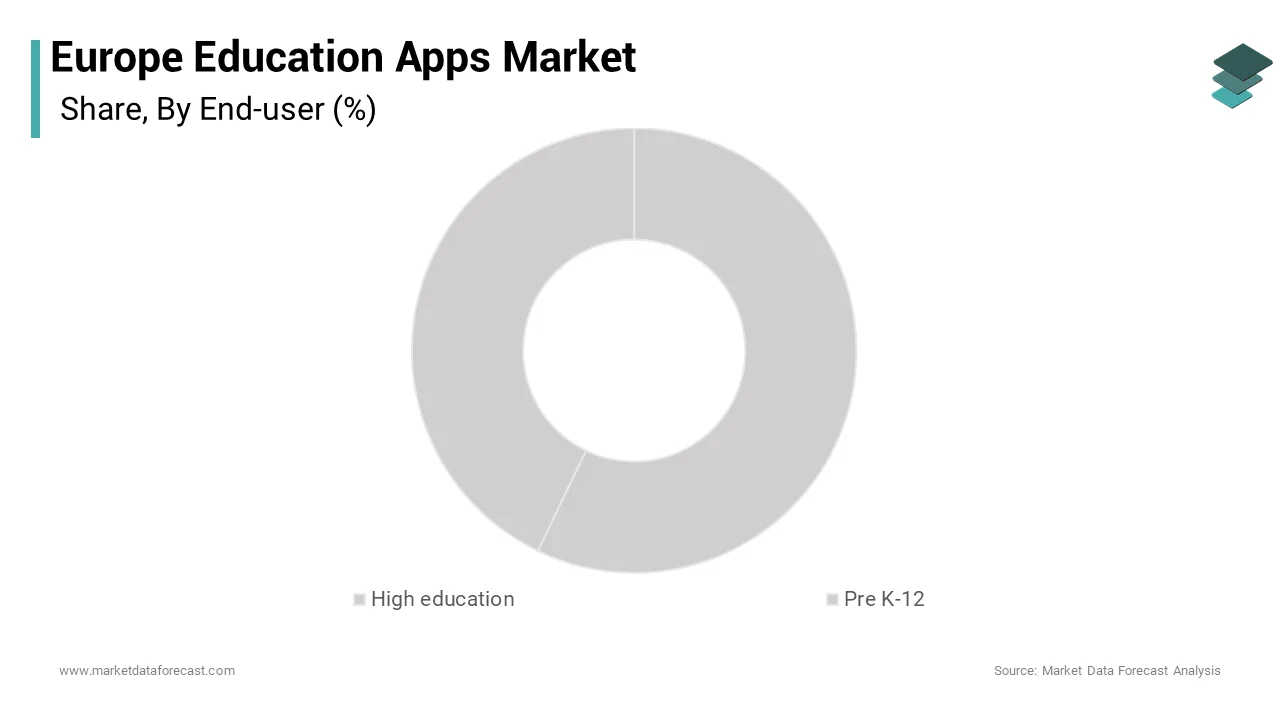
However, the higher education segment is predicted to witness the fastest CAGR of 15.45 over the forecast period in the European market owing to the increasing demand for flexible and accessible learning options, among university students and lifelong learners. The rise of massive open online courses and micro-credential programs has transformed how tertiary education is delivered and consumed. According to the European University Association, there is a significant shift towards hybrid learning models, where digital platforms complement face-to-face lectures. Students are increasingly relying on mobile apps for collaborative study, research, and access to digital libraries. As per the Organisation for Economic Co-operation and Development, participation in tertiary education has reached record levels in many European countries, creating a large pool of potential users for specialized academic apps. The need for continuous professional development drives working professionals to enroll in online degree programs and certification courses, offered through educational applications. Universities are partnering with edtech providers to create custom apps, that enhance student engagement and administrative efficiency. The globalization of higher education encourages cross-border enrollment, which is facilitated by digital learning tools. The flexibility of mobile learning allows students to balance studies with work and personal commitments. This segment benefits from the higher willingness to pay for premium content and career-oriented skills. The integration of artificial intelligence for personalized tutoring further enhances the appeal of higher education apps.
By Product Insights
The mobile-based segment led the market by commanding for the highest share of 64.5% of the regional market in 2025 due to the ubiquity of smartphones and tablets, which provide convenient and anytime, anywhere access to educational content. According to Statista, the number of smartphone users in the world today in 2024 is 4.88 billion, which translates to 60.42% of the world’s population owning a smartphone. The portability of mobile devices allows students to engage in microlearning sessions during commutes or breaks, enhancing overall study efficiency. As per the GSMA, there are now over 12.172 billion mobile connections worldwide. App stores offer a vast array of educational applications, catering to various subjects and age groups, making discovery and installation easy for users. The intuitive touch interfaces of mobile devices are particularly appealing to younger learners, who are digital natives. Push notifications and reminders help maintain user engagement and consistency in learning habits. The lower cost of mobile apps, compared to desktop software, makes them accessible to a broader audience, including students from lower-income backgrounds. Developers prioritize mobile-first strategies to capture the largest possible user base. The integration of mobile-specific features, such as cameras for augmented reality experiences and voice recognition for language practice, adds unique value. The dominance of mobile operating systems ensures a standardized development environment. This segment benefits from the continuous improvement in mobile hardware capabilities.
On the other hand, the web-based segment is experiencing the fastest growth in the Europe education apps market and is estimated to showcase a CAGR of 13.3% over the forecast period owing to the increasing adoption of cloud-based learning management systems and comprehensive online course platforms that require larger screens and more processing power. According to the European Commission, the shift towards remote and hybrid work has normalized the use of web browsers for professional and educational activities. Web-based applications offer greater functionality and interoperability with other enterprise systems, such as student information systems and corporate HR platforms. As per Gartner, the demand for cloud infrastructure services in Europe is growing at a significant rate, as educational institutions and corporations seek scalable solutions. Web-based platforms allow for easier updates and maintenance, without requiring users to download new versions. They are particularly preferred for complex tasks, such as coding simulations, data analysis, and collaborative projects, that benefit from keyboard and mouse inputs. The ability to access web apps from any device with a browser enhances flexibility for users, who switch between laptops, tablets, and desktops. Educational institutions favor web-based solutions for their centralized management capabilities and robust security features. The growth of browser-based gaming and interactive simulations also contributes to this segment. The elimination of storage constraints on local devices makes web apps attractive for users with limited device capacity. This segment caters to users seeking deeper and more immersive learning experiences.
By App Insights
The LMS segment led the market by holding the leading share of 31.5% of the regional market in 2025. The essential role these systems play in organizing, delivering, and tracking educational content for schools, universities, and corporations is majorly driving the dominance of the LMS segment in the European market. According to the European Schoolnet, most educational institutions in Europe have adopted a Learning Management System, as the backbone of their digital infrastructure. These platforms provide a centralized hub for course materials, assignments, grades, and communication between teachers and students. As per the International Society for Technology in Education, the integration of Learning Management Systems with other educational tools creates a cohesive ecosystem, that enhances operational efficiency. The mandatory shift to remote learning, during recent global disruptions, accelerated the adoption of these systems. Institutions require robust platforms, that can handle large numbers of concurrent users and ensure data security in compliance with GDPR. Learning Management Systems offer scalability, allowing institutions to expand their digital offerings without significant additional infrastructure costs. The ability to generate detailed analytics on student performance helps educators identify areas for improvement. Corporate training departments also rely on these systems, for employee onboarding and compliance training. The standardization of features, such as discussion forums and quiz modules, makes them indispensable. The stickiness of these platforms ensures long-term retention and recurring revenue for providers. The continuous addition of multimedia and collaborative features keeps them relevant.
On the other hand, the adaptive learning apps segment is anticipated to showcase a promising CAGR of 15.5% over the forecast period in the European market owing to the increasing demand for personalized education, that caters to individual learning styles and paces. According to the European Commission, artificial intelligence-driven adaptive learning technologies are recognized as key enablers for inclusive and effective education. These apps use algorithms to analyze student responses and adjust the difficulty and type of content in real time. As per the European Commission, 88.3% of people aged 16 to 74 years in the EU reported using the internet on a daily basis during the 3 months preceding the ICT survey in 2024. The ability to identify knowledge gaps and provide targeted remediation makes adaptive apps highly effective for test preparation and skill acquisition. Students appreciate the tailored experience, which reduces frustration and increases motivation. The technology is particularly beneficial for subjects with clear right and wrong answers, such as mathematics and languages. The availability of large datasets allows for more accurate modeling of learning paths. Educational institutions are piloting adaptive learning programs, to supplement traditional teaching. The rise of lifelong learning encourages adults to use these efficient tools for upskilling. The integration of gamification elements enhances engagement, while maintaining pedagogical rigor. The proven efficacy of adaptive learning drives investment and adoption. This segment represents the future of personalized digital education.
COUNTRY LEVEL ANALYSIS
United Kingdom Education Apps Market Analysis
The United Kingdom maintains its status as the largest market for education apps in Europe by holding 25.2% of the regional market share in 2025. This dominant position of the UK in the European market is attributed to a mature edtech ecosystem and strong government support for digital innovation in education. According to the Department for Education, the UK government has provided substantial funding for digital education platforms, to support remote learning. The presence of leading universities and research institutions drives the development of advanced educational technologies. As per the BankMyCell report in 2024, the United Kingdom has a smartphone penetration of 82.20% of its population owning a smartphone. The high level of English proficiency facilitates the adoption of global education apps. The competitive academic environment encourages students and parents to seek supplementary learning tools. The regulatory framework supports innovation, while ensuring data protection standards are met. The prevalence of remote and hybrid learning models, post-pandemic, has sustained demand for digital solutions. Partnerships between schools and tech companies accelerate the integration of apps into curricula. The strong consumer spending power allows for higher adoption of premium subscription services. The focus on STEM education drives demand for specialized coding and science apps. These factors collectively ensure that the UK remains the primary driver of the European education apps market. The continuous innovation in AI and adaptive learning keeps the market dynamic.
Germany Education Apps Market Analysis
Germany accounted for the second largest share of the European education apps market in 2025. The robust vocational training system and increasing digitization of schools are propelling the German market expansion. According to the Federal Ministry of Education and Research, the Digital Pact for Schools has allocated billions of euros to modernize digital infrastructure in educational institutions. This funding has accelerated the adoption of learning management systems and educational applications in classrooms. As per Statista, 64.8 million people in Germany were smartphone users in 2024. The dual education system creates demand for apps that support practical skills and theoretical knowledge. The strong manufacturing sector drives the need for technical and engineering education apps. Privacy concerns are paramount in Germany, influencing the choice of compliant and secure platforms. Local developers focus on creating high-quality content, aligned with state-specific curricula. The aging population drives interest in lifelong learning and language acquisition apps. The government’s emphasis on digital sovereignty encourages the development of local solutions. Collaborations between public institutions and private providers foster innovation. The steady economic growth supports investment in educational technology. These dynamics sustain Germany’s prominent position in the regional market. The focus on quality and reliability appeals to discerning users.
France Education Apps Market Analysis
France is predicted to register a healthy CAGR in the European education apps market during the forecast period due to strong government initiatives and a culture that values education. The French Ministry of National Youth and Sports has launched programs to integrate digital tools into primary and secondary education. According to the National Institute of Statistics and Economic Studies, 49.6 million people in France were smartphone users in 2024. The presence of major telecommunications companies supports the infrastructure needed for widespread app usage. As per the French government, the digital transformation of the education system is a national priority, involving significant public funding. The emphasis on French language and culture drives demand for localized content. The competitive higher education sector encourages students to use test preparation and tutoring apps. The government’s support for French language learning globally creates opportunities for export-oriented apps. The urban population is highly connected and eager to adopt new educational technologies. The focus on equality in education drives the development of free or subsidized apps for disadvantaged students.
COMPETITIVE LANDSCAPE
The competition in the Europe education apps market is characterized by intense rivalry among global edtech giants specialized language learning platforms and emerging local startups. Established players leverage their extensive content libraries and brand recognition to attract and retain users. These companies focus on continuous innovation through artificial intelligence and adaptive learning technologies to differentiate their offerings. Meanwhile niche providers compete by offering specialized content in specific subjects or languages that appeal to targeted audiences. The market sees frequent collaborations between app developers and educational institutions to enhance credibility and reach. Regulatory compliance particularly regarding data privacy and child safety serves as a key differentiator influencing user choices. Apps that demonstrate robust security measures and transparent data practices gain a competitive advantage. The availability of free content creates pressure on monetization strategies forcing companies to prove value through premium features. User experience and interface design are critical factors affecting adoption and retention rates. The rapid pace of technological change requires continuous investment in research and development. This dynamic environment fosters a culture of innovation and quality improvement. Localized content and cultural relevance are essential for success in diverse European markets. Companies must balance global scale with local customization to thrive.
KEY MARKET PLAYERS
A few of the market players that are dominating the Europe education apps market are
- 2U Inc.
- 3P Learning Ltd.
- Age of Learning Inc.
- Babbel GmbH
- Alphabet Inc.
- Brilliant Worldwide Inc.
- Chegg Inc.
- Coursera Inc.
- Duolingo Inc.
- Epic Creations Inc.
- Hologo World Inc.
- IXL Learning Inc.
- Khan Academy Inc.
- Lumos Labs Inc.
- Memrise Ltd.
- Microsoft Corp
- Quizlet Inc.
- Sololearn Inc.
- Udemy Inc.
- UMU Technology CO. LTD.
- WizIQ Inc.
Top Players In The Market
- Duolingo Inc stands as a dominant force in the Europe education apps market leveraging its gamified approach to language learning. The company contributes significantly to the global market by offering accessible and engaging courses in numerous languages. Duolingo has recently enhanced its platform with artificial intelligence features such as Duolingo Max which provides personalized feedback and explanations. This innovation allows users to practice conversational skills and understand complex grammar rules more effectively. The company actively expands its course offerings to include subjects like mathematics and music broadening its appeal beyond language learners. Duolingo focuses on user retention through streaks and leaderboards which foster consistent daily usage. Their commitment to making education free and accessible drives widespread adoption across diverse socioeconomic groups. The company continues to invest in research to improve learning outcomes through data driven insights. These strategic initiatives reinforce its position as a leader in mobile education. Duolingo’s strong brand recognition and viral marketing strategies ensure sustained growth. The integration of adaptive learning technologies enhances the personalization of the user experience.
- Babbel GmbH plays a critical role in the Europe education apps market by providing structured and practical language courses designed for real life conversations. The company contributes to the global market by emphasizing pedagogical effectiveness and cultural context in its curriculum. Babbel has recently launched specialized business language courses to cater to professional development needs. This expansion addresses the growing demand for career oriented language skills among European workers. The company utilizes speech recognition technology to provide immediate feedback on pronunciation enhancing the learning experience. Babbel focuses on short manageable lessons that fit into busy schedules promoting consistent progress. Their content is developed by linguistic experts ensuring high quality and accuracy. The company actively partners with corporations to offer employee language training programs. These B2B initiatives diversify revenue streams and strengthen market presence. Babbel’s emphasis on privacy and data security aligns with strict European regulations. The continuous update of course materials keeps content relevant and engaging. These efforts demonstrate Babbel’s commitment to effective and practical language education. The company’s localized approach resonates well with European users seeking specific language proficiency.
- Coursera Inc is a prominent player in the Europe education apps market known for its partnerships with top universities and companies. The company contributes to the global market by offering a wide range of online courses degrees and professional certificates. Coursera has recently expanded its enterprise offerings to help organizations upskill their workforce efficiently. This strategy addresses the critical need for continuous professional development in a rapidly changing job market. The platform provides access to high quality content from prestigious European institutions enhancing its local relevance. Coursera focuses on flexible learning paths that allow users to balance education with work commitments. The company integrates hands on projects and peer assessments to ensure practical skill acquisition. Their mobile app enables offline learning which increases accessibility for users with limited connectivity. Coursera actively promotes degree programs that provide recognized credentials for career advancement. The emphasis on data science and technology courses meets the high demand for digital skills. These initiatives solidify Coursera’s position as a key provider of higher education and professional training. The platform’s scalability supports millions of learners globally.
Top Strategies Used by the Key Market Participants
Key players in the Europe education apps market primarily focus on personalization and artificial intelligence integration to enhance user engagement and learning outcomes. Companies leverage machine learning algorithms to adapt content difficulty and pacing to individual student needs. This approach improves retention rates and ensures effective knowledge acquisition. Another major strategy involves expanding into B2B markets by offering corporate training solutions and institutional licenses. This diversification reduces dependency on individual consumer subscriptions and creates stable revenue streams. Partnerships with educational institutions and employers help validate content quality and increase credibility. Gamification elements are widely used to motivate users and encourage consistent practice. Developers also prioritize mobile first designs to ensure accessibility and convenience for learners on the go. Compliance with data privacy regulations such as GDPR is a critical strategic priority to build trust. Continuous content updates and the addition of new subjects keep the platforms relevant and competitive. These strategies collectively drive growth and maintain a strong market position.
MARKET SEGMENTATION
This research report on the Europe education apps market is segmented and sub-segmented into the following categories.
By End-user
By Product
By App Type
- Learning Management Systems (LMS)
- Adaptive Learning Apps
- Educational Games
- Assessment and Grading
- Learning Management Systems (LMS)
- Adaptive Learning Apps
- Educational Games
- Assessment and Grading
By Delivery Mode
- SaaS (Software as a Service)
- On-Premise
- Cloud-Based
- SaaS (Software as a Service)
- On-Premise
- Cloud-Based
By Target Audience
- Students
- Teachers
- Parents
- Administrators
- Students
- Teachers
- Parents
- Administrators
By Country
- UK
- France
- Spain
- Germany
- Italy
- Russia
- Sweden
- Denmark
- Switzerland
- Netherlands
- Turkey
- Czech Republic
- Rest of Europe