

Microsoft AI Tour Zurich: Setting Direction in the AI Era
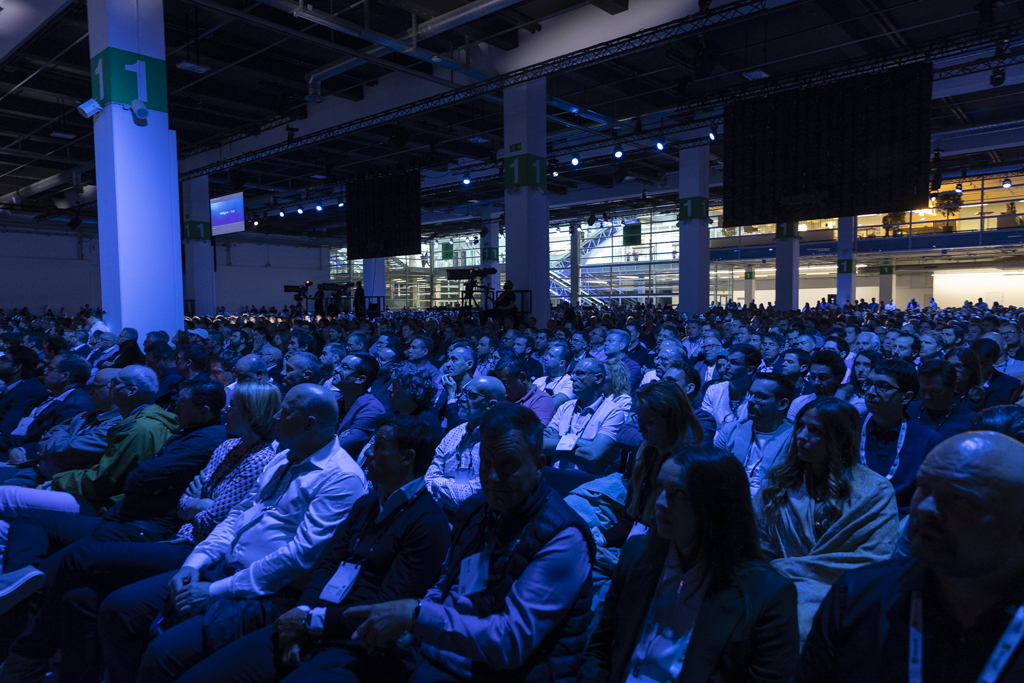
Zurich, 29 April 2026 – Microsoft brought its global AI Tour to Zurich today, convening more than 2,500 business leaders, customers, and partners at Messe Zürich to demonstrate how artificial intelligence is moving from experimentation to large-scale business deployment across Switzerland. The event underscored a clear shift: AI is no longer confined to pilots but is increasingly embedded into core operations, decision-making, and business strategy.
Leadership, People and Trust at the Heart of the AI Transformation
In her opening speech, Catrin Hinkel, CEO of Microsoft Switzerland, set the tone by placing people at the center of AI‑led transformation. She emphasized that AI delivers real impact when clear leadership decisions define where it is applied, strengthen human judgment, and create space for what matters most. As AI moves from optimization to transformation, she highlighted the importance of making deliberate choices about where human expertise remains essential.

“AI only delivers impact when leadership turns it into action,” said Catrin Hinkel, CEO of Microsoft Switzerland. “Organizations that move from experimentation to transformation combine technology with governance, trusted data, and human expertise. With its unique ecosystem of industry, research, and innovation, Switzerland is well positioned to lead in AI – applying it responsibly and at scale.”
Looking ahead, Hinkel emphasized that leadership in the AI era is defined by the ability to set clear direction amid rapid change. Rather than waiting for certainty, organizations need to move forward by making informed choices, building the capabilities and confidence to shape AI adoption in line with their values of trust, security, and digital sovereignty.
From AI Experiments to Frontier Transformation
In his keynote, Judson Althoff, CEO of Microsoft’s Commercial Business, described Frontier Transformation as a holistic reimagining of business, aligning AI with human ambition to achieve an organization’s highest potential. Frontier Firms embed AI into the core of their business; integrating it across workflows, decision‑making, and operating models to deliver meaningful outcomes and growth.

In Switzerland, where a strong innovation ecosystem meets deep industry expertise, this approach is already taking hold. Organizations are moving from experimentation to embedding AI at the core of how they operate and create value.
In a dedicated keynote on digital sovereignty, Mark Chaban, Corporate Vice President Commercial Cloud Solutions EMEA at Microsoft, addressed how organizations can maintain control over data, infrastructure, and technology choices while scaling cloud and AI adoption. He emphasized that digital sovereignty and business strategy are not opposing goals, but must be actively reconciled.
Swiss organizations integrate AI into core workflows
Across Switzerland, organizations are putting this approach into practice, demonstrating how AI is moving from experimentation to execution:
- ABB showcases how AI is delivering measurable value in industrial environments. By embedding generative AI and Copilot capabilities directly into devices and systems, ABB is translating complex industrial data into actionable guidance for engineers and technicians on the shop floor. This enables faster decision‑making, reduced downtime and more proactive operations across sectors such as energy, manufacturing and chemicals.
- Urbasolar, part of the Axpo Group, demonstrates how AI can support sustainability goals alongside business performance. Using an AI‑powered solution built on Microsoft Azure, Urbasolar enables teams to access and analyse biodiversity data in seconds, supporting evidence‑based decisions in solar project development. The approach embeds environmental stewardship into daily workflows and shows how AI can turn complex data into practical insight for long‑term impact.
- Vaudoise highlights how organizations in highly regulated environments are maturing their cloud and AI adoption at scale. By establishing a centrally governed platform for security, compliance and operations, while empowering application teams to innovate within clear guardrails, Vaudoise is strengthening resilience and accelerating innovation, demonstrating how cloud maturity enables long‑term business impact and human‑centered productivity.
Together, these examples reinforced the day’s core message: AI in Switzerland is no longer a future aspiration, but an operational reality, translating innovation into efficiency gains, improved customer experiences and the creation of new business models.
A Long‑Term Partner in Switzerland’s Digital and AI Transformation
The Zurich event also reinforced Microsoft’s long‑term commitment to Switzerland and its role as a trusted partner in the country’s digital and AI transformation. Announced in June 2025, Microsoft’s USD 400 million investment strengthens Switzerland’s cloud and AI backbone by increasing capacity across its existing datacenters near Zurich and Geneva. The investment delivers advanced AI capabilities to more than 50,000 customers while ensuring data remains within Swiss borders – a critical requirement for regulated sectors such as finance, healthcare and government.
In parallel, Microsoft is scaling its skilling efforts, with the goal of equipping one million people in Switzerland with AI and digital skills by 2027. More than 500,000 have already been skilled. Together, these investments underscore Microsoft’s commitment to working alongside Swiss customers, partners and institutions to strengthen economic resilience, enhance global competitiveness and advance responsible AI innovation across the country.