

AI as a Driver of Growth
Croatia has strong foundations for the real, reliable and widespread adoption of artificial intelligence, which will be critical for the next phase of economic growth. However, the key challenge today is no longer the availability of AI, but the speed and scale of its adoption across the economy and public sector. This was the central message of the event marking 30 years of Microsoft’s operations in Croatia.
Although Croatia ranks in the mid-range among European countries in terms of AI adoption, the gap between organizations that have integrated AI into their daily operations and those still in the experimental phase is rapidly widening — and this gap will ultimately define future economic competitiveness.
“The question is no longer whether we should use artificial intelligence, but how quickly and responsibly we can use it to create real business and societal value. By learning from more mature markets, Croatia has an opportunity to leapfrog certain stages of development and accelerate its progress,” said Kalin Dimtchev, Microsoft’s Regional Director for the Adriatic.

The event brought together representatives of the Government of the Republic of Croatia, as well as leading domestic companies and institutions. Representatives from Orbico, Infobip, the Croatian Health Insurance Fund and Končar highlighted that investments in artificial intelligence is already delivering tangible results through process optimization, increased employee productivity, innovation, and improved customer experience.

Croatia: from potential to implementation
Over the past decade, Croatia has made significant progress in digitalization; however, data shows that the full potential of artificial intelligence has yet to be realized. Currently, 59% of citizens possess basic digital skills, around 45% of companies use cloud computing, while the level of AI adoption is estimated at approximately 23.7%. This gap between existing digital infrastructure and real-world adoption represents the greatest opportunity for further progress of Croatia.
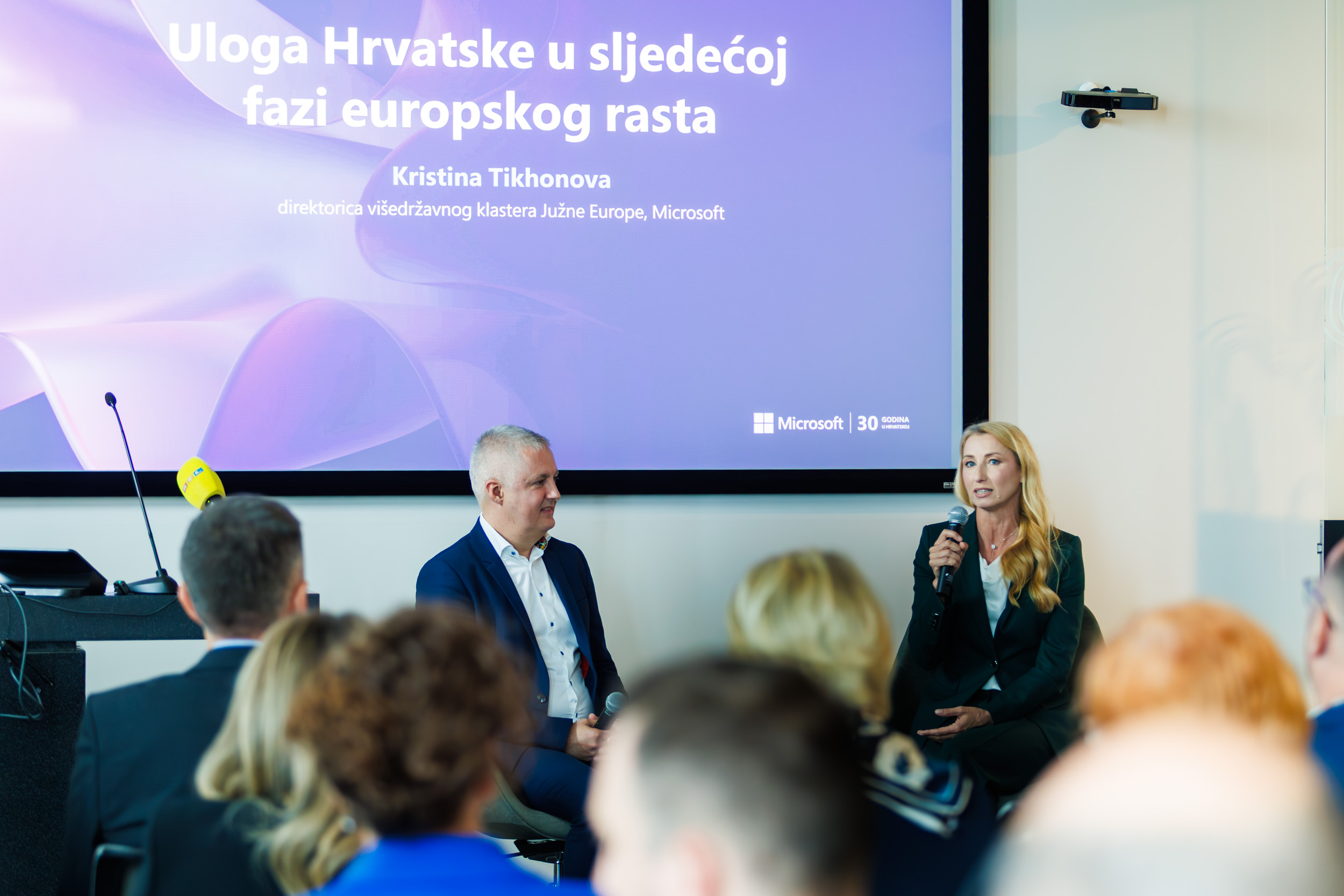
“The biggest breakthrough does not come from technology itself, but from the ability of organizations and institutions to work with their own data, build own competencies, and embed AI into everyday operations. This is where we see the greatest difference between those creating measurable value and those still in the testing phase,” said Kristina Tikhonova, General Manager for the South Multi-Country Cluster at Microsoft.

Local ecosystem: a foundation for acceleration
Over the past three decades, Microsoft has built a strong local ecosystem in Croatia, employing more than 50 professionals and collaborating with over 100 partner organizations. In cooperation with the Ministry of Science and Education, CARNET and SRCE, more than 500,000 students, teachers, and faculty members have access to Microsoft 365 tools, supporting the systematic development of digital and AI skills. At the same time, through startup support programs, nearly 80 innovative Croatian companies have used approximately USD 5 million in Azure credits over the past four years. In addition, free digital skills training programs are available through pan-European initiatives on LinkedIn, Microsoft, and GitHub Learn platforms.
Further development of artificial intelligence in Croatia will depend on strong collaboration between government, industry, and the education system.
Trusted European AI infrastructure
To support the growth of AI adoption, Microsoft is making significant investments in European data infrastructure. Over the past two years, data centre capacity has increased by 40%, with plans to exceed 200 data centres across 16 European countries and regions by 2027.
Through the Microsoft EU Data Boundary, organizations can store and process data within the European Union, ensuring high levels of transparency and compliance with regulatory frameworks.
For Croatian organizations, this means access to infrastructure that enables secure and scalable deployment of AI solutions, with full control over data and compliance with European standards such as GDPR and the EU AI Act.
Digital sovereignty and cybersecurity – foundations of trust
As AI adoption grows, digital sovereignty and cybersecurity are becoming increasingly important topics for European institutions and businesses.
“Digital sovereignty today is a defining element of organizational control. It implies an organization’s ability to fully manage its own data and to clearly understand how that data is used, regardless of where it is stored or which processes or individuals have access to it. It is precisely this level of control that becomes the foundation of trust in the modern digital economy,” said Ratko Mutavdžić, Global Public Sector Advisory Lead at Microsoft.

“Digital sovereignty is not possible without strong cybersecurity, which is the foundation of trust, control and resilience in the digital world. Artificial intelligence elevates security to a new level, from advanced threat detection to proactive defence. In that environment, organizations that continuously invest in security not only manage risks, but also build the foundations of trust and resilience in the digital economy,” added Tomislav Vračić, Regional Technology Director for the South Multi-Country Cluster at Microsoft.
Looking ahead
Looking ahead, Microsoft continues to contribute to the development of the digital economy in Croatia through partnerships and support for shaping national initiatives and strategies, relying on advanced technologies, expertise and a strong partner ecosystem. In a time of rapid technological change, organizations that move from experimentation to widespread and systematic application of AI will play a key role in shaping the future development of the Croatian economy.