

African Professionals Rush to AI Training as Global Digital Skills Race Accelerates
By Adonis Byemelwa
As its future workforce faces the increasing pressure of preparing for a rapidly changing digital economy, thousands of African professionals are flocking to artificial intelligence training programmes.
Whether in banking halls in Nairobi, technology hubs in Lagos, or classrooms in Addis Ababa, professionals across sectors are increasingly looking for AI skills that maximise productivity and adaptability to a fast-changing workplace, as well as competitiveness.
Among them is Margaret Njeru, a trade finance and payments professional focused on SWIFT operations, real-time gross settlement systems, compliance monitoring and financial risk controls.
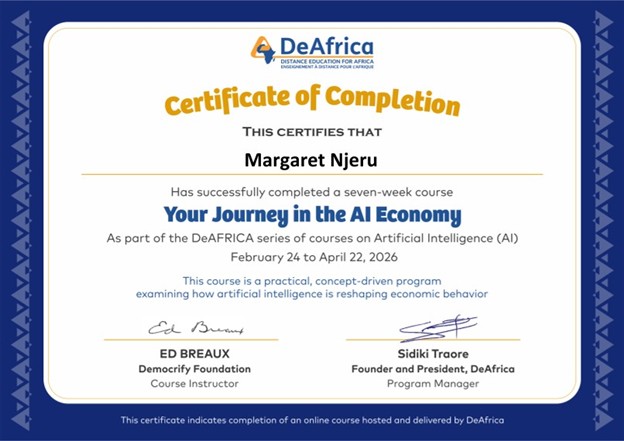
This week, Njeru revealed that she had finished a certification course called “Journey in the AI Economy,” through Distance Education for Africa (DeAfrica).
Thus far for Njeru, the course was more than just earning a certificate. “The course was great, because in banking operations, accuracy and good judgement are everything,” she said of her experience with the program in an interview.
While AI can help expedite processes, it still requires professionals to have the rigour to examine outputs critically. That ratio of speed to human touch became one of my biggest learnings.
That lesson is becoming more important throughout Africa. Africa has among the youngest populations in the world, yet for too many economies, unemployment, underemployment, or compounded digital divides persist.
The International Finance Corporation estimates that millions of digital jobs could be created in Africa by 2030, but only if governments and institutions are proactive and aggressive in investing in digital skills and internet access.
Meanwhile, the rapid advancement of generative AI technologies has also heightened workers’ fears that parts of their jobs may eventually be automated.
Nevertheless, for professionals such as Njeru, it is not about replacing us. It is about adaptation. She said, “I realised AI is not limited only to software engineers when I started the programme.
“It could assist professionals in operations, compliance, reporting, data analysis and decision making. The key is knowing where it helps and where human intervention must refer her judgment.
Njeru stated that the course encouraged participants to start by assessing their current knowledge, then practice with AI tools in practical, low-stakes environments.
Participants discussed ways to use AI for writing assistance, workflow automation, literature summaries, generating new ideas and interpreting data. The program focused more on experimentation and continuous learning than on theory alone.
That pragmatic strategy is drawing talent from industries not typically associated with tech. Educators, financial professionals, and development advocates hailed AI proficiency as a growing workplace requirement in response to Njeru’s accomplishment.
Many noted that recent years had seen more women joining digital upskilling programmes in areas traditionally dominated by men.
Christine Chimfwembe, a youth mentor who advocates for leadership within the female community, applauded more inclusivity in AI education projects.
Involving more women in these courses is encouraging, because it is necessary to ensure that digital transformation becomes holistic and inclusive,” she said. If we exclude women from emerging technologies, existing disparities will be magnified.
Distance Education for Africa, which administers the programme, says demand has surged in the last 12 months.
The photo, taken on Saturday, shows students in an artificial intelligence-related course at DeAfrica, a digital platform for learning and knowledge.
“There is massive demand from young professionals who know that digital skills are not merely optional, said Traore. “People want real-world knowledge that they can use in their places of work and the communities.
Traore said many attendees were coming from other sectors, including banking, education, public administration, entrepreneurship, logistics, and health care.
This demand mirrors a trend across African economies, as firms fast-track digital transformation initiatives launched during and in response to the COVID-19 pandemic.
Organisations are investing in more automation tools; you can find several examples, such as fraud detection techniques, transaction monitoring tools, customer support systems or compliance reporting.
Telecom companies that are measuring network efficiency and customer engagement are deploying AI systems, while startups are testing agricultural tools, language technologies, and health diagnostics using AI.
Nonetheless, while the prospects for widespread AI adoption look bright, some experts worry that limiting access to training materials could exacerbate inequality.
Internet prices are still high in many countries on the continent; electricity is erratic in some areas; and access to advanced digital infrastructure ranges widely, from urban to rural areas.
Misinformation, weak regulatory frameworks, and attendant ethical risks from poorly supervised AI systems also raise alarm bells.
“Technology cannot solve structural problems on its own,” said Sarah Mwongela, a digital policy researcher in Nairobi focusing on emerging technology and labour issues across East Africa.
“The rewards of AI will be reserved for a small number of people unless countries invest in education systems, digital infrastructure and governance frameworks.”
However, for many professionals, waiting for the ideal circumstances is no longer a viable option. One of the most important things Njeru said he learned from the programme was to approach AI with curiosity, not fear.
I learned not to feel overwhelmed by the pace of change, she said. The secret is to start small, use the tools responsibly, and build your knowledge over time.
This is a paradigm shift that matters more and more as AI advances far more quickly than institutions can adapt.
Competition is on to deploy short courses in digital literacy, coding, data analytics and AI fundamentals by universities, private training centres, non-profit organisations and employers across Africa.