

In wartime Ukraine, the state is deploying super app for the future
Digital transformation and reskilling are challenges during the best of times, but Ukraine’s wartime achievements with technology deployment for its citizenry are a unique success story.
Despite the full-scale Russian invasion, which happened nearly four years ago and continues to this day, the Ukrainian government has continued working towards President Volodymyr Zelenskyy’s goal of building a “state in a smartphone,” an aim that has now evolved to becoming an “agentic state” as artificial intelligence advances.
The government is doing this via Diia, an integrated digital platform and super app, with access to streamlined public services, business resources, and digital literacy education.
“Our main goal is to make sure that every Ukrainian is competitive, has a high-paying job and is successful in life,” said Valeriya Ionan, advisor to Mykhailo Fedorov, Ukraine’s First Deputy Prime Minister for Innovation, Education, Science and Technology. Ionan spearheads the free edutainment platform Diia.Education.
According to a government report, 60% of Ukrainians ages 18 to 70 use Diia to conduct online public services, up 24% since 2021. Ukraine has more than 160 public services available on the app, including e-marriage (one of Time’s Best Inventions of 2024)
As for Diia.Education, it’s used by nearly three million Ukrainians, 75% of whom complete their courses (this is exponentially higher than industry standards, which can be as low as 5%). This education has led to an increase in digital literacy of 12.5% in 2023 and 10.5% in 2025, the two most recent years when Ukraine published studies (after a decrease that traces back to high-skilled Ukrainians leaving the country during the war and rapid technological advancement).
Users of all ages can use the platform to improve digital skills, acquire certificates, learn how to use online services and discover new careers. All of this helps to keep people economically active during displacement, relocation, job loss, or career changes triggered by the war.
While emerging technology poses worries of job loss, digital literacy “can serve as a bridge to opportunities in emerging fields” and “further enhances access to remote work and the gig economy, creating employment opportunities for historically marginalized populations,” according to global think tank UNU.
Plus, even basic digital literacy helps protect Ukrainians during what is widely considered the most technological war in history.
“Ukraine has been the testing ground for Russian cyber weapons for the last 10 years,” said Jeremiah Fowler, co-founder and cybersecurity researcher at Security Discovery, who has discovered thousands of data breaches and scams.
“The weakest link in every cybersecurity scenario is the human aspect,” Fowler said. “That basic knowledge can help people say, ‘Maybe I don’t want to download this software or click this mysterious link.’ That’s a very good first step of defense.” He adds that Diia uses top instructors who would otherwise charge a premium to share that knowledge.
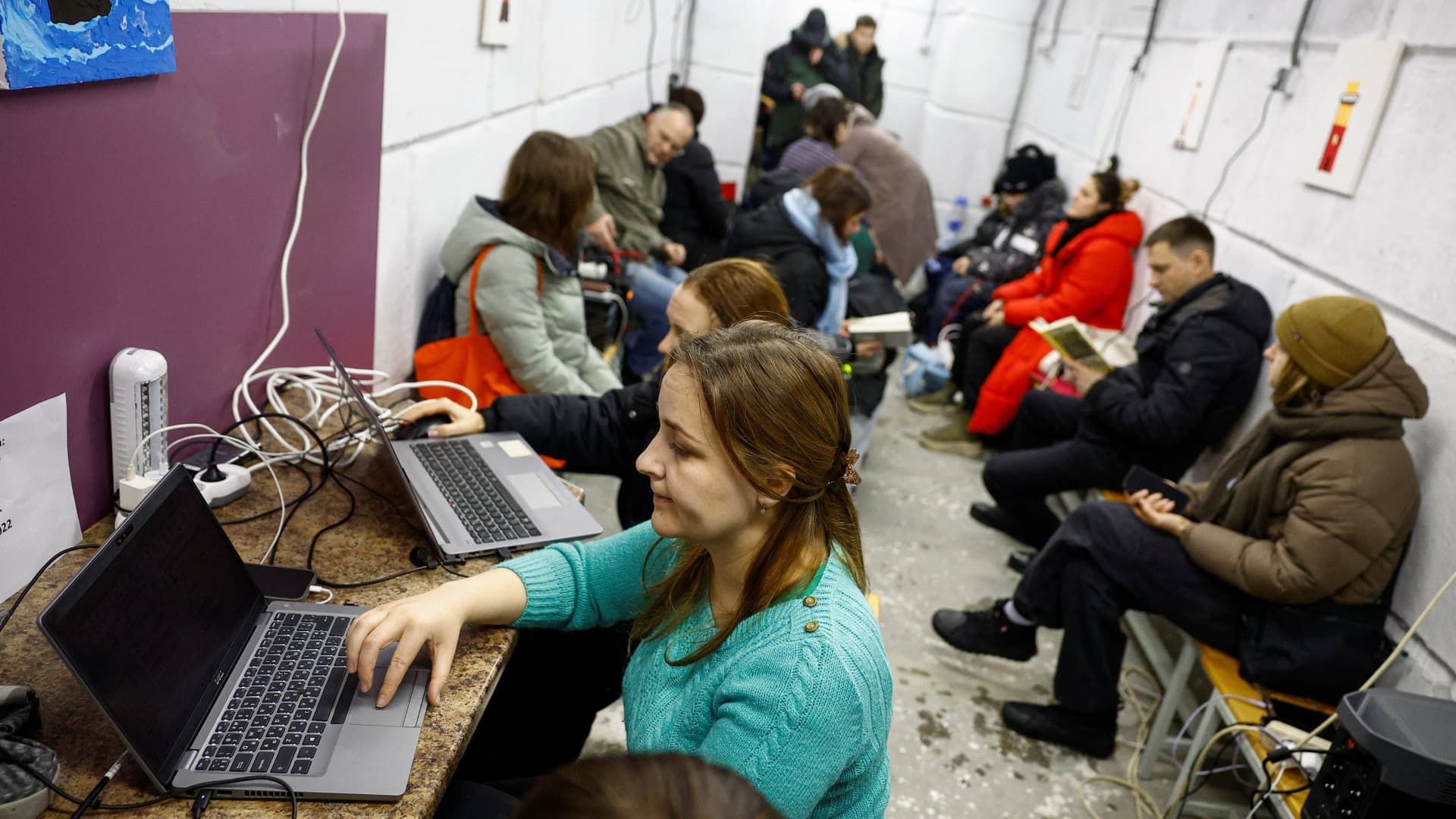
Diia.Education and the broader Diia ecosystem, which have won awards and are ranked on various global indices, have evolved despite missile attacks, power outages and military conscription that have changed life for Ukrainians.
Fowler, originally from the U.S., spent 14 years living in Ukraine. Since the full-scale invasion began, Germany has been his homebase, though he regularly travels back and forth. He recognizes that “many Ukrainian people just do not have the luxury that people outside of a war zone have,” like taking gap years or coasting on outdated education. “People are really working hard on every skill they have because of uncertainty.”
In the U.S., public-private partnerships for tech education exist, like the Virginia Has Jobs program, a state initiative with Google that works to close gaps in AI education for students and the workforce. However, many educational initiatives of this kind are siloed within the private sector, with reskilling an internal effort at companies.
Ukraine’s Diia.Education first launched in 2023 with help from a Google.org grant of $2 million. The free lifelong learning platform joined the broader Diia ecosystem, which first began in 2019 under the newly launched Ministry of Digital Transformation. Diia.Education is integrated with national job platforms and supported by more than 5,000 offline education hubs across the country, providing access for people without stable connectivity. In Ukraine, 19% of adults have no access to the internet via a fixed broadband connection (compared to 9% in the U.S.).
For people with limited internet access as well as the elder population, Ukraine developed a program for librarians on how to facilitate someone’s first contact with a computer. Using these governmental resources, libraries across the nation have launched workshops to promote digital literacy regardless of someone’s starting point.
“The training opened up new opportunities for communicating with my grandchildren and helped me keep up with the times with confidence,” Lyudmila Perkun, a Ukrainian senior citizen who now knows how to pay for utilities online, said in a case study.
Ukraine broadcasts basic education videos on network television, which directs people to Diia.Education to learn more. As a further incentive, certain individuals are eligible to receive 1,000 hryvnia (roughly $25) as a sign-up bonus for the main Diia app.
While Diia.Education is an edutainment platform, it’s not a competitor in the marketplace. “Our main goal is to promote the market, not to take part in it,” said Ionan. “We are working with almost all the edtech providers. We are using their content and doing lots of partnership projects.”
Fowler believes that Ukraine’s efforts to educate its population are a prime example of investing in your people. “Like any investment, you want that to grow, blossom and then return on that investment,” he said. “In this case, the return on investment is an educated population that has higher incomes. Higher incomes allow for better tax contributions and more opportunities, because these educated people start businesses, hire other people. It’s a chain reaction of just doing the basics at the bottom, without trying to make it into a profit model for the shareholders.”