

UK government use of data analytics to tackle fraud ‘underdeveloped’, say MPs

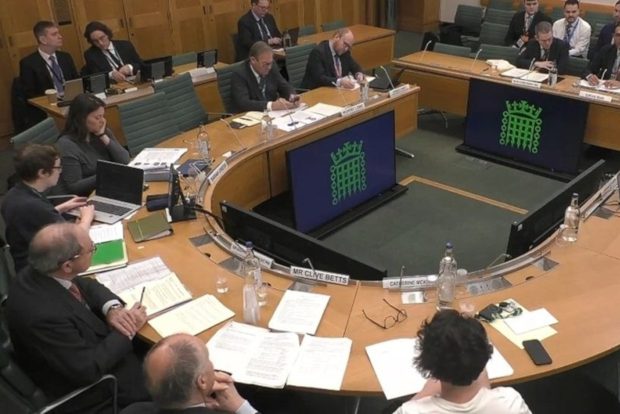
Public accounts committee session: PSFA chief executive Mark Cheeseman, DSIT permanent secretary Emran Mian, and director-general for public spending (HMT) and Government Finance Function joint-head Conrad Smewing on 15 January I Credit: Global Government Finance screenshot of parliamentlive.tv session broadcast
The use of data analytics to tackle fraud and error is “underdeveloped” across the UK public sector, a House of Commons committee has said in a report that makes six recommendations.
An estimated £55bn to £81bn (about US$73bn-US$108bn) is lost annually to fraud and error across UK government – mostly through the tax and welfare systems – but there has been a “lack of ambition and activity to deploy new technology widely,” the Public Accounts Committee (PAC) said in the report published on 27 March.
The committee’s Government use of data analytics on error and fraud report warns that problems such as legacy technology and lack of digital leadership “still persist”. The Roadmap for Modern Digital Government, published by the Government Digital Service (GDS) – part of the Department for Science, Innovation and Technology (DSIT) – in January, is specifically criticised as lacking detail.
“While government says using data analytics to tackle error and fraud could save taxpayers up to around £6 billion per year, the PAC lacks confidence all public bodies are set up to achieve such savings,” the committee said. “Little detail exists on how and when such a saving will be achieved, as government’s digital and counter-fraud experts do not have a robust plan to support public bodies to make fraud and error savings through data analytics.”
“The roadmap says government will embrace AI and replace outdated tech – but contains little detail on how and when this will be done, and nothing on how it will help tackle fraud and error,” it added.
Follow our sister title Global Government Finance on LinkedIn
PAC: action must match ‘loud ambitions’
“Our committee has long identified a failing in digital leadership and fragmented data across government as one of the main blockers in government’s ability to deliver,” PAC chair Sir Geoffrey Clifton-Brown said in a press release accompanying the 28-page report.
“One of the most obvious areas in which new technology could protect the taxpayer’s pound is in error and fraud. But while this government has talked a big game on embracing new technology, its delayed Roadmap for Modern Digital Government fails to even mention how this will tackle fraud and error, and it continues to struggle with the dead weight of legacy technology. We are not convinced that the government is making best use of fast-moving technology such as AI to tackle the difficult subject of fraud,” he said.
“There are specific actions that this committee will continue to raise which government could take to back up its loud ambitions,” Clifton-Brown continued. “It could enable better information sharing across departments: DSIT could gain the heft a small department with such a big responsibility needs by appointing a government chief digital officer; and it could move with more speed to place digital experts at the top decision-making table of each department – a PAC recommendation government has already accepted.”
“We hope to see a robust plan from government in this area. Without one, government will only be able to mouth its disapproval as billions in public money continue to roll out of the door into the hands of fraudsters,” he warned.
The PAC heard evidence from representatives from HM Treasury, DSIT and the Public Sector Fraud Authority (PSFA) on 15 January to help it compile the report. The PSFA – which was established in 2022 to lead the government’s response to fraud against the public sector – agrees annual targets for fraud and error savings with all central government departments and tracks how they perform but the targets and savings are not made public, the PAC noted.
Read more: UK government flows sanctions data into AI-powered fraud-detection tool
Gov: ‘aggressive’ action underway
The government issued a press release on 27 February highlighting its efforts to tackle fraud against the state.
It said that £7.53bn (US$9.93bn) “has been protected for the public purse in the last financial year through aggressive fraud prevention and recovery” by the government’s Counter Fraud Function.
It highlighted “work with local authorities” and “innovative data-matching tools” such as the National Fraud Initiative (NFI) – which matches electronic data within and between public and private sector bodies to prevent and detect fraud – as having particularly helped.
The government also said it was “intensifying our [public authorities’] hunt” for Covid-related fraud, with “almost £400 million in savings delivered to date” – the same figure was published in a government announcement in December 2025 on an independent report by Covid counter-fraud commissioner Tom Hayhoe that found that many financial relief schemes “were rolled out with huge fraud risks and no early safeguards”; and that “weak accountability, bad quality data and poor contracting” were the primary causes of £10.9bn (US$14.4bn) Covid fraud losses.
The government is also establishing a Public Authorities Fraud Investigation and Enforcement Service by 2026-27. “Highly skilled investigators specifically tasked with pursuing the recovery of fraud against the public sector” are being recruited, it said.
Read more: Cat-and-mouse game: company registers up the ante against fraudsters
Algorithms in the spotlight
The PAC highlighted that in its report titled ‘Use of AI in Government’, published last year, that about 28% of central government systems were out of date, and that a 2023 recommendation for all departments to have a digital expert on their boards had not yet been achieved, despite being accepted by government.
The committee reiterated warnings from last year’s AI report about a lack of transparency on algorithm-assisted decision-making from government. At that time, only 33 records had been published on the government website set up to provide that transparency. At the time of its latest report’s publication last week, “there were still only 125, and DSIT told the PAC that it knows that not all the expected cases have been recorded”, the PAC stated.
“Only 11 records at Feb 2026 mentioned ‘fraud’,” the PAC continued. “Departments are not doing enough to be transparent or build public trust in government’s use of data analytics to tackle fraud, and DSIT should ensure that all government bodies record their use of algorithms for transparency, so that all relevant uses of AI and machine learning are captured.”
The PAC’s report also notes a “limitation” in current legislation in how government can deploy modern data analytics techniques to fight fraud.
“The law does not allow for individual profiling, meaning that government is not allowed to flag known fraudsters as an indicator for future fraud detection work, while NFI data can only be retained for two years,” it stated.
Read more: Global Government Finance’s Anti-Fraud & Financial Crime topic section
PAC’s six recommendations
The PAC makes six recommendations, which are each split into multiple points.
First is for HM Treasury to require public bodies to set out in their annual reports what they are doing to tackle fraud and error, including information about the targets they agree with the PSFA and how they are performing against these targets; and that public bodies should be required to set out the type of counter-fraud activity they are undertaking and how they intend to improve performance.
Second is for GDS, the PSFA and the Government Finance Function to set out “how they will work together to deliver the reduction in fraud losses that data analytics can achieve, with clear targets and milestones”.
The third is a trio of points related to digital skills, including for DSIT to “mandate that there are digitally skilled leaders at board level in all government departments, and all arms-length bodies (ALBs) where technology plays a key part in their actions”.
The fourth sets out that the PSFA should write to the PAC within six months to “explain its progress in developing a library of counter-fraud controls”; and should set out its steps to “identify and address issues with data-sharing” through the Digital Economy Act.
The fifth recommendation is that DSIT should ensure that all government bodies comply with the Algorithmic Transparency Recording Standard (first published in 2021, this requires public-sector organisations to publish information about their use of algorithmic tools), and “should continuously monitor, update and ensure compliance with guidance around data analytics transparency to ensure that it maximises transparency without assisting fraudsters”.
The committee pointed out that current legislation limits government’s ability to deploy data analytics to tackle fraud and error: for example, the Local Audit and Accountability Act, introduced in 2014, does not allow for profiling of individuals’ behaviours.
The PAC’s sixth recommendation is that the PSFA “should review the legislation impacting its ability to implement fraud and error data analytics and communicate to Parliament where it believes additional powers or other changes to legislation would be helpful”; and that DSIT and the PSFA “should review the regulatory regime around government’s fraud and error activities and communicate to Parliament where they believe additional powers or other changes to legislation would improve controls for specific fraud and error risks”.
Read more: UK Government publishes new fraud strategy as cases hit record level
Government: ‘already delivering’
Responding to the report, the government described tackling fraud and error as a priority and insisted that it was “already delivering”.
“At the last Spending Review [June 2025], £14 billion of efficiencies were secured and the Public Sector Fraud Authority is driving further savings across government through tough action on prevention, recovery and enforcement,” a government spokesperson told Global Government Finance on 27 March.
“We won’t stop there,” the spokesperson continued, stating that the Roadmap for Modern Digital Government “sets out how we will responsibly use AI and modern data analytics to strengthen leadership, improve data sharing and crack down harder on fraud with clear transparency and safeguards in place so the public can be confident these tools are used appropriately and proportionately”.
Instead of appointing a government chief digital officer, DSIT permanent secretary Emran Mian last year assumed leadership of the digital and data profession and function. Within DSIT, two directors-general report to Mian with responsibility for supporting digital transformation across government and the digital products that GDS builds and runs.
The government published its long-awaited new strategy to tackle fraud across the economy in early March. This was published just days ahead of Cifas, a UK non-profit membership association bringing together the private and public sectors to tackle fraud and financial crime, revealing that more than 444,000 cases were recorded to the National Fraud Database in 2025 – the highest number ever recorded in a single year, and a 6% increase on the previous year.
This article was originally posted on the website of our sister title, Global Government Finance. Sign up to the Global Government Finance newsletter.