

Preparing future-ready public health professionals: a blended, AI-integrated pedagogical innovation | BMC Medical Education
Higher education is undergoing a transformative shift from traditional passive instruction to learner-centred methodologies that encourage students to construct knowledge actively rather than receive it passively. This evolution is especially significant in health and medical education, where applied knowledge, critical thinking, and digital fluency are essential to navigate complex, real-world challenges [1, 2]. Within this evolving context, blended learning has emerged as a powerful pedagogical approach, integrating digital tools with experiential strategies such as industrial visits and expert interactions to deepen student engagement, flexibility, and autonomy [3, 4].
Blended learning facilitates cognitive engagement by linking theoretical content with authentic, real-world exposure. Through activities like field visits and simulations, students are able to internalize information more effectively and develop professional competencies such as teamwork, ethical reasoning, and critical thinking [5,6,7]. In this context, the educator transitions from a content deliverer to a learning facilitator, enabling reflective, interdisciplinary engagement [8].
Parallel to these pedagogical developments is the integration of generative Artificial Intelligence (AI) tools such as ChatGPT in higher education. These tools have revolutionized how students access, process, and synthesize information. When used ethically and critically, generative AI supports assignment writing, summarizing complex materials, and fostering active learning [9, 10]. However, it also necessitates a rethinking of teaching strategies to ensure students can appraise, critique, and validate AI-generated information, thereby aligning with the core principles of digital literacy and academic integrity [11,12,13].
To harness the benefits of AI, particularly in health education, it is essential to adopt pedagogical frameworks that blend AI-generated content with grounded, experiential learning. Such integrated approaches promote critical evaluation, contextual understanding, and self-directed learning. This is particularly relevant in public health and occupational health education, where theoretical frameworks must be matched with field-based realities such as workplace hazards and disease prevention strategies [14, 15].
Generative AI, when paired with experiential methods such as industrial visits and expert discussions, enables students to validate AI outputs through real-world context. This blended, mixed-methods pedagogy fosters deeper understanding and a sense of ownership over learning, aligning with Bloom’s higher-order cognitive domains analysis, synthesis, and evaluation [16]. Moreover, it supports essential competencies such as digital literacy, evidence-based reasoning, and collaborative problem-solving [17, 18].
Studies have shown that integrating AI into blended learning environments enhances student motivation, supports active learning, and improves educational outcomes, especially in applied disciplines [19, 20]. In occupational health education, AI tools can bridge the gap between textbook content and workplace complexity by enabling students to explore scenarios, identify risks, and develop preventive strategies [21, 22].
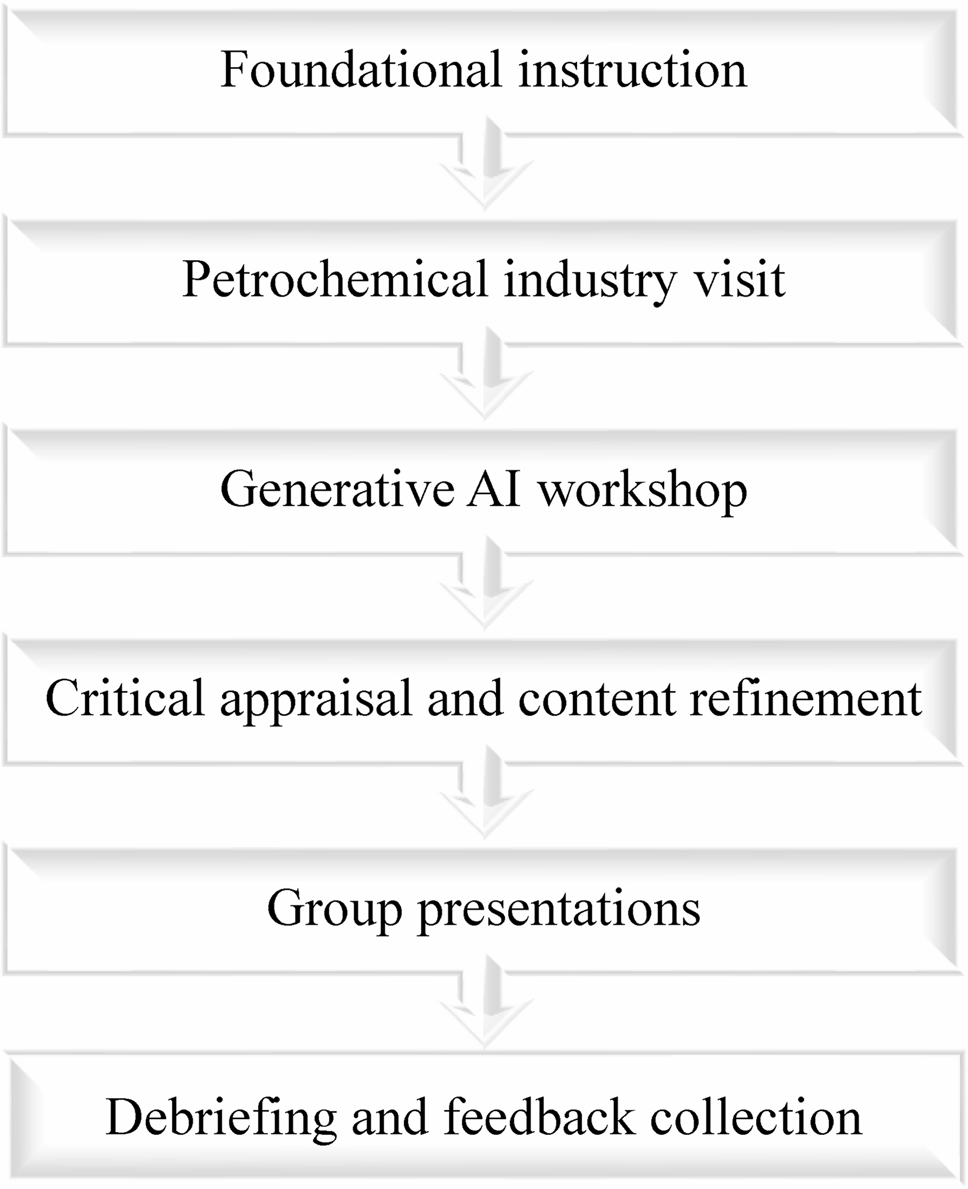
The present study explores a pedagogical intervention that combines generative AI and experiential learning in the teaching of occupational health. Following industrial visits and expert interactions, students engaged with ChatGPT to explore industry-specific hazards and prevention strategies, generating structured outputs while verifying sources and citations. The study evaluates this blended learning model’s impact on student engagement, knowledge retention, digital skill acquisition, and perceived relevance to real-world public health challenges. Thus, this integrated approach not only supports the development of AI literacy but also reinforces applied knowledge and reflective thinking key competencies for future-ready public health professionals.