

Privacy Booths in Libraries: A Quiet Revolution
Through the Library Infrastructure Facility Improvement (LIFI) grant from the Texas State Library and Archives Commission (TSLAC), libraries across the state are transforming into essential spaces for life’s most important moments. These aren’t just upgrades. They’re quiet revolutions.
Inside newly installed privacy booths and study rooms, patrons are attending telehealth appointments, participating in legal depositions, interviewing for jobs, and making critical phone calls they can’t take at home. With reliable high-speed internet and sound-insulated spaces, libraries are no longer just places to get online. They are places where important, even life-altering decisions happen.
The impact goes beyond physical spaces. Libraries are expanding access with extended hours, reducing waitlists, and investing in secure technology that protects patron data. Even small software upgrades are making a big difference, ensuring that every session is private, professional, and safe.
Behind the scenes, library teams are building lasting capacity. They’re strengthening partnerships with IT departments, learning to manage complex projects, and empowering staff to take on new leadership roles.
The result is something bigger than a grant cycle. LIFI is helping redefine what libraries are: trusted community infrastructure that supports health, employment, education, and justice. One private room at a time.
Impact of the LIFI Program
Imagine walking into a Texas public library and seeing what this grant has quietly set in motion:
- A mom slips into a sound‑insulated study room because it’s the only place she can escape the noise at home to make an important phone call.
- Down the hall, someone is in a telehealth appointment with their doctor.
- In another library location, a resident is sitting in a legal deposition, participating fully in the justice system from inside their local library.
- Across the state, a job‑seeker is using a grant‑funded room for a video interview they never could have done in a crowded living room.
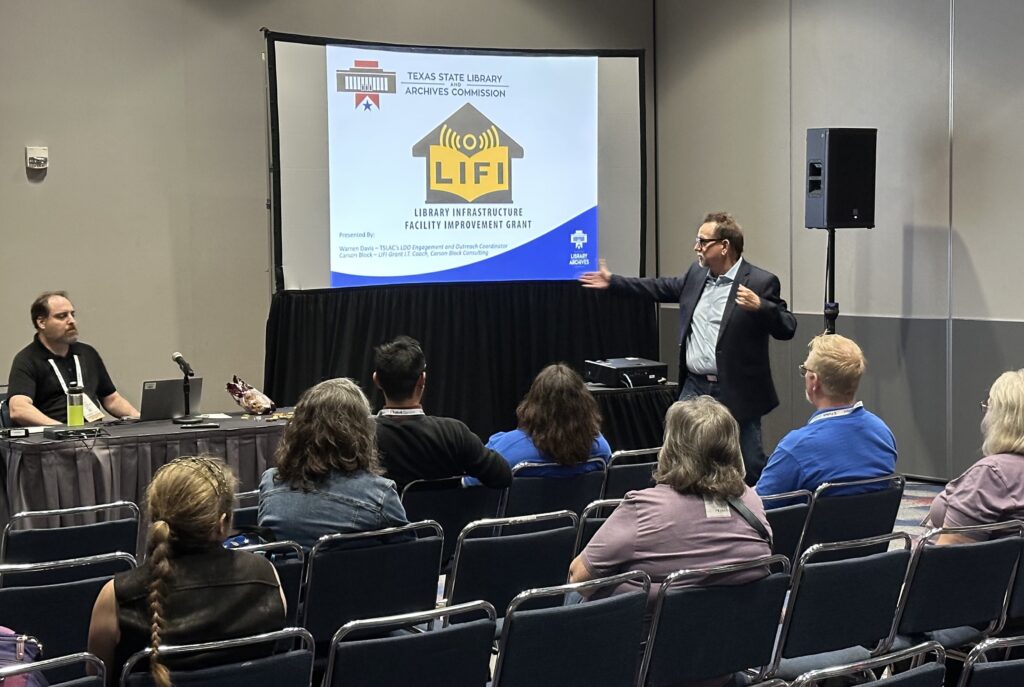
These aren’t hypothetical scenarios, they’re real stories from the LIFI Grant cohort, as shared at a gathering at the 2026 Texas Library Association conference. The meet-up was hosted by TSLAC staff and Carson Block, LIFI’s technology coach who facilitates a monthly training cohort of library grantees with new privacy booths to share best practices. This isn’t a grant about gadgets. It’s about turning Texas libraries into frontline infrastructure for opportunity, justice, and health—one quiet room, one secure session, one patron story at a time.

What changed?
With LIFI / WiFi support, libraries have transformed from “places with Wi‑Fi” into critical infrastructure for real‑life decisions:
- Private, high‑bandwidth space on demand: New rooms and booths are being booked for interviews, depositions, telehealth, testing, and sensitive calls, the moments when privacy, quiet, and connectivity matter most.
- Trustworthy technology, not just more computers: Small investments in software are having outsized effects: public PCs that wipe every trace of personal data between sessions, better session management, and cloud‑based tools that teach patrons how to work the way employers and schools now expect.
- From “overbooked” to “we can say yes”: Libraries that were maxed out on meeting space and computer time can now extend hours, add capacity, and reduce waitlists, turning “sorry, we’re full” into “yes, we can fit you in.”
- Digital ACCESS with dignity: Patrons aren’t just getting online, they’re doing it in spaces that feel professional, private, and safe, which changes how they experience government services, health care, job searching, and education.
What did libraries learn?
Behind the scenes, libraries are leveling up in ways that will outlast any single grant cycle:
- They learned that time buffers are non‑negotiable. A “one‑week” project can easily become a month once city IT, facilities, and legal get involved.
- They discovered that door hinges, locks, and access systems can make or break a project, and that vendor assumptions need to be checked early and often.
- Directors learned to trust and empower their staff, shifting from “I’ll do it all myself” to “We’ll build this together.”
- And perhaps most importantly, they learned how to navigate complex relationships with city IT, turning tension into partnership with help from the coaching team.
Why it matters beyond this cohort
Because the state library is updating annual reporting to track these new spaces and services, the impact of this grant won’t disappear when the money is spent. It will:
- Show up in statewide data on meeting space, connectivity, and digital access.
- Feed a steady stream of real‑world stories about jobs obtained, cases heard, and patients seen, that make broadband funding feel concrete and human.
LIFI / WiFi Grant – Lessons Learned
These anonymized testimonials show that beyond new rooms and equipment, the grant is building lasting institutional capacity: better project management, stronger vendor and IT relationships, empowered staff, and more robust policies that will continue to support digital access.
1. Time and Project Management
- “We had to add a few months to our expected finish.” – Small‑city public library
- “I thought I could get this done in a week or a few days, and a month later I’m still not done.” – Suburban public library
Key lesson: Libraries learned that time contingency is critical. Once procurement, facilities, IT, and policy reviews are involved, even seemingly simple projects can take significantly longer than expected.
2. Vendors, Hardware, and Hidden Details
- “We ordered new booths as part of the grant and assumed we could do the same thing as our existing study rooms with remote locks. We couldn’t. These are not normal doors.” – Mid‑size public library
- “Double‑checking with vendors on what you think you’ll be able to do, like switching out the locks, is really important.” – Same library
Key lesson: Infrastructure details (doors, locks, access systems) can determine what’s possible. Libraries learned to verify assumptions with vendors early, ensuring that products align with how they intend to manage access, security, and privacy.
3. Delegation and Building Internal Capacity
- “The best thing I’ve learned is that you can delegate your staff to do things. I get really excited about the project and forget that we have qualified staff who are willing to help. It’s a lesson: I need to listen more often.” – Library director, small community
Key lesson: Project leads realized they don’t need to manage every detail alone. Delegating to capable staff spreads workload, grows local expertise, and makes the improvements more sustainable beyond the grant period.
4. Working with IT and City Tech Support
- “I know what I need and what I want, and then IT puts in their two cents. They’re not really understanding, or not trusting, that I know what I want. At the final step it’s, ‘You didn’t need this, you didn’t need that,’ and I’m thinking, what the heck?” – Public library relying on city IT
- “If you’re having issues like that, we can help you figure out how to make that communication happen. These problems are individual to each library and IT department, but at the end of the day they’re working for you—even if it doesn’t always feel that way.” – Grant‑funded coaching team
Key lesson: Using city or centralized IT can save money but adds complexity. Libraries highlighted the importance of:
- Clearly stating library service requirements,
- Building mutual trust with IT partners, and
- Having access to coaching or mediation when communication breaks down.
5. Policy, Legal Review, and Opening New Spaces
- “Our gaming space is set up, but we’re waiting on the lawyer to approve the policy. We want the policy in place before the room is visible.” – Small‑town public library
Key lesson: Physical setup is only one step. Libraries learned to plan for policy creation, legal review, and rollout strategies as essential components when launching new spaces like gaming rooms, telehealth rooms, and private study areas.
LIFI / WiFi Grant – Community Impact Stories
These stories show that the LIFI / WiFi grant is doing far more than purchasing equipment. It is enabling private, connected spaces for critical life activities, enhancing privacy and security, expanding digital skills, and creating lasting capacity that will benefit communities across the state long after the grant period ends.
1. Quiet, Private Spaces for Real‑Life Needs
- “We added a double study room with this grant, and it’s amazing how often it’s used. One patron told us she had to get away from home, away from the kids, and came to the library because it was the only quiet, private place where she could use her phone.” – Small‑city public library
Impact: New study rooms and quiet spaces are giving residents privacy and calm they cannot find at home, supporting:
- Sensitive phone calls
- Online forms and appointments
- Quiet work and study
2. Multi‑Purpose Rooms: Jobs, Justice, and Health
- “We chose to build a full room instead of a small booth. It’s already being used for job interviews, depositions, and telehealth. The same space can serve one person or a small group, and it’s become a go‑to private room for serious needs.” – Mid‑size public library
Impact: Grant‑funded rooms are supporting high‑stakes activities that directly affect employment, legal outcomes, and health:
- Job interviews for people who don’t have professional, quiet space at home
- Legal depositions, ensuring access to the justice system
- Telehealth visits, giving patrons private, connected space to meet with healthcare providers
3. Extending Hours and Capacity
- “Before the grant we were basically overbooked. Now, with the new space and expanded hours tied to this project, we can say ‘yes’ to more people who need a place for meetings, studying, or remote work.” – Suburban public library
Impact: Grant resources are being used to create spaces where more residents can rely on the library as a consistent, dependable hub for connectivity in the following areas:
- Add more hours of access
- Increase room and technology capacity
- Reduce waiting lists and turn‑aways
4. Privacy and Security on Public Computers
- “A small part of our project was software that normally wouldn’t be funded. We upgraded our public computer management system and added software that wipes everything at the end of each session, tax info, search history, all of it. It’s a small budget line, but it’s a big change for us.” – Small‑town public library
Impact: Even modest investments in software have:
- Strengthened patron privacy, especially for tasks like taxes and benefits applications
- Improved security and reliability of public computers
- Made the computing experience feel more professional and trustworthy
5. New Technology and Digital Skills
- “We’ve set up a gaming and technology space and just deployed nine new computers. We’re using free online Microsoft tools, so patrons are learning how to work in the cloud, signing in, saving, and managing files online instead of just on a desktop.” – Rural public library
Impact: Libraries are:
- Introducing modern digital workflows (cloud tools, accounts, online storage)
- Reaching youth and adults through gaming and media spaces
- Building skills that directly translate to school, remote work, and everyday life online
6. Storytelling and Statewide Visibility
- “As your projects get completed and we start to see the impact, we want to tell your stories. We’re updating our annual reporting to track these meeting spaces, especially reservable ones, so this work will show up in the data for years to come.” – State library agency staff member
Impact: The grant is not only changing individual libraries; it is also:
- Shaping statewide statistics on digital access and meeting space availability
- Creating a pipeline of success stories that demonstrate how broadband and libraries work together
- Helping policymakers and partners see concrete, measurable outcomes from their investment